How Rehabilitation Therapy Helps Improve Recovery and Quality of Life in Bangalore
Published on 9/7/2026Bangalore is a city where life is always on the move. Known for its growing professional opportunities, the city attracts people from across India who come here to build their careers and lives, often managing long working hours, daily commutes, packed schedules, and responsibilities beyond work.
This can become particularly challenging when a family member undergoes surgery or suffers an injury and requires continuous support during post-discharge recovery. While families want to provide the best possible care, being physically present throughout the day is not always practical.
Recovery does not necessarily end when a person leaves the hospital. As discussed earlier, the period after discharge can be an important phase of recovery, when an individual needs continued support to regain strength, mobility, independence, and the ability to return to everyday activities.
In such situations, Specialized Therapy in Bangalore can provide structured rehabilitation support during this important transition between hospital care and returning to everyday life.
Balance Between Personal and Professional Lifestyle in Bangalore
The lifestyle of a working professional in Bangalore generally requires a lot of time management. In addition, office responsibilities, meetings, deadlines, and daily long commutes make effective lifestyle balance an essential part of everyday life.
For someone caring for an elderly parent, spouse or another family member recovering from surgery or injury, this routine can become even more demanding and challenging. Recovery may require regular therapy, assistance with movement, medication schedules, follow-up appointments and support with everyday activities.
The reality is that one person may not always be able to balance full-time caregiving with professional and personal responsibilities. This is where planned post-operative and rehabilitation support can become relevant for families living in a fast-paced city.
Challenges in Providing Continuous Post-Surgical Care
After an injury or operation, a person may need considerably more support than they did before or in the hospital. For a working family member, providing this level of continuous assistance can be challenging. Frequent hospital or therapy visits can also require additional planning and time management.
There may also be situations where the patient needs emergency assistance while a family member is at work. For elderly individuals, the need for supervision can be even greater when they have reduced strength, mobility, or balance after hospitalisation. It highlights the practical difficulty of providing continuous care alongside professional commitments.
A structured rehabilitation setting can help bridge this gap by providing appropriate recovery support while allowing family members to remain involved in the patient's care.
The Importance of Post-Operative Care
The recovery process does not simply end when a patient leaves the hospital. The period after discharge is an important stage in helping the patient return to everyday life, as the body may still need time and structured support to regain strength, mobility, and function. A guide to rehabilitation across the continuum of care by WHO has highlighted how rehabilitation can support recovery, improve functioning, and help prevent complications related to different health conditions.
Post-operative care involves following medical instructions, taking prescribed medication on schedule, attending necessary follow-ups, and participating in rehabilitation or physiotherapy when recommended by the treating healthcare professional.
Rehabilitation care may help address areas such as:
- Regaining strength
- Improving flexibility
- Rebuilding balance and coordination
- Gradually improving mobility
- Supporting independence in everyday activities
- Developing confidence in movement
- Returning gradually to normal routines
Recent research on rehabilitation and post-acute care has highlighted the importance of appropriate rehabilitation in helping people regain physical function and independence following illness, injury and surgery.
Benefits of Rehabilitation Centre in Bangalore
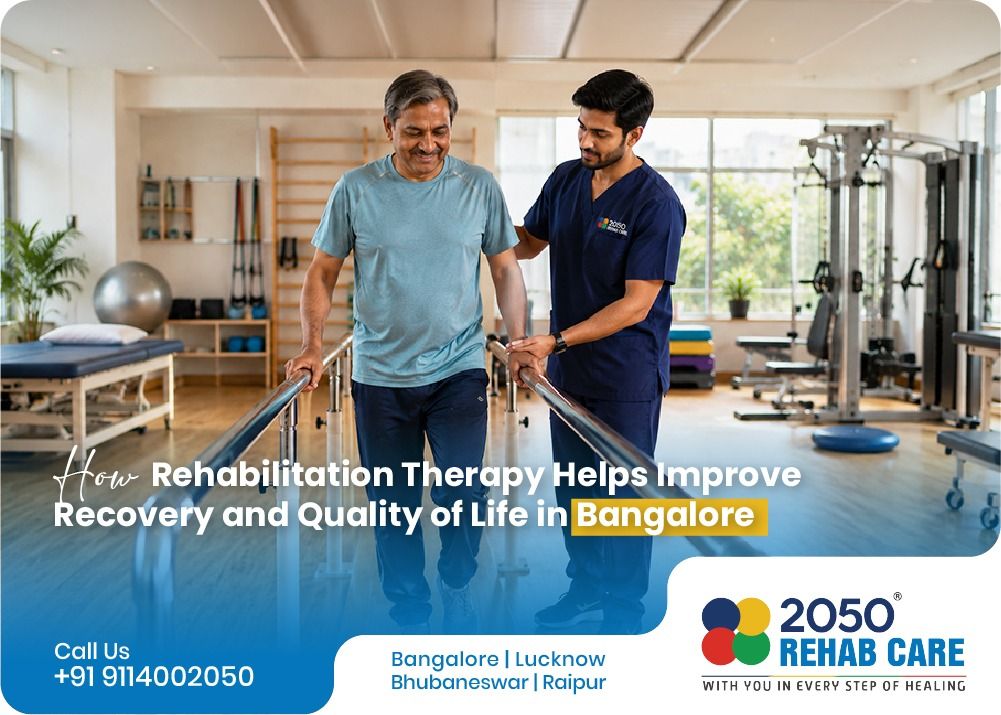
A rehabilitation centre brings therapy, care, and structured support together under one setting. For a person recovering after surgery, injury, or prolonged illness, recovery may involve regular therapy, mobility assistance, nursing support, medical supervision, and a structured daily routine. Coordinated rehabilitation services can help bring different aspects of recovery together based on an individual's needs, as explained by WHO.
Managing all these requirements at home can be challenging for family members with heavy professional responsibilities in a fast-paced city like Bangalore. A Rehabilitation Centre in Bangalore can therefore provide a structured setting where individuals receive the support required during their recovery. Perks of a rehabilitation centre include:
- Dedicated rehabilitation facilities: Equipment and spaces designed for physiotherapy, mobility training, strengthening and other therapeutic activities.
- Regular therapy and supervision: Patients can follow a planned therapy schedule rather than depending entirely on family members to organise exercises and appointments.
- Nursing and care support: Patients who require assistance with daily activities can receive support from trained care staff, reducing the need for a family member to remain available throughout the day.
- Medical oversight: Appropriate clinical supervision can help ensure that the patient's recovery is monitored and that concerns can be communicated to the relevant healthcare professionals.
- Structured daily routine: Regular therapy, rest, meals and other recovery-related activities will be organised into a consistent routine.
- Support for mobility and daily activities: Patients who have difficulty walking, standing or performing routine activities will receive personalised assistance.
Another consideration is the time involved in travelling repeatedly for different recovery-related requirements. We are all aware of Bangalore's traffic and long travel times, which make frequent appointments difficult to coordinate with work schedules. A structured rehabilitation arrangement can help organise therapy and recovery activities more efficiently.
Supporting Rehabilitation and Recovery in Bangalore with 2050 Rehab Care
When a person gets discharged from the hospital after surgery, the recovery journey is far from over. They often need extra care, attention, and support to get back to their normal routine. With the right care and rehabilitation, recovery can become smoother and more manageable. But in a busy city like Bangalore, providing this close and continuous care can be challenging when work, commuting and everyday responsibilities are already part of daily life.
2050 Rehab Care provides specialized therapy in Bangalore with personalized care, therapy, nursing assistance, clinical supervision, and structured recovery support based on individual needs. Its rehabilitation services cater to a wide range of recovery needs, including neurological, orthopedic, cardiac and pulmonary, post-operative, geriatric, sports injury, spine injury, oncology, pediatric, gastro and post-stroke rehabilitation. With dedicated therapy zones, physiotherapy and neuro-rehabilitation facilities, strength and mobility training, nutritional support, and multidisciplinary clinical care, the focus is on helping patients regain function, strength, mobility, and independence throughout their recovery journey.
Just had surgery? Contact Us for Specialized Therapy in Bangalore to understand the rehabilitation support that may be appropriate for your recovery needs.